Jim Connolly Marketing

  • Home
  • About
    • About Jim Connolly
    • Jim’s small business marketing newsletter
    • Top Marketing Tips for 2026
    • Privacy Policy
    • How I use cookies
    • Contact
    • Disclosure
  • Let’s Grow Your Business

Social media marketing and real world results

By Jim Connolly | June 11, 2012

This post is about how social media marketing can help your business generate targeted, high quality leads.

Here’s what we know about the more traditional approach to lead generation:

  • Somewhere close to you this morning, a group of small business owners will be attending an early morning networking breakfast, each hoping that someone gives them a lead.
  • At another location, a small business owner is wondering what will happen, when her radio commercial is played today.
  • Another business owner, will be standing by the phone, waiting for the response to his latest mail shot.
  • Then there will be the business owner, waiting to see what happens when the magazine she advertised in gets published today.
  • Finally, one business owner will be summoning up the courage to start making cold calls.

Those are some common ways for small business owners to try and get business leads.

Another approach – Social media marketing

Social media marketing allows us to network on a local, national or global scale. It allows us to build targeted networks of great contacts, based on our specific area of commercial interest. The cost is extremely low and there’s no cost barrier to building as big and successful a network as you can. For those of us who add blogging to our social media marketing mix, we can also showcase our expertise and knowledge to these amazing people, so they can get a real handle on who we are and the value we bring.

This blog and my other social media marketing accounts, generate sales and business leads for my business all day, every day. This means I have the freedom to run a successful small business, whilst living in a beautiful, rural location, with clients and customers worldwide, and never need to attend networking events, pay for advertisements or pay for any other type of marketing.

Online and offline – It’s all about people

If you’re thinking that social media marketing only works for businesses that are mainly based online, consider this. I was prompted to write this post after receiving 2 messages on the same day, from 2 totally unconnected people. They give a perfect example of the way online and offline have fused together.

  • Irene Koehler wanted to know if my ears were burning, because at a meeting in California, Kelly Kim, the co-founder of Twylah, mentioned me to her. These professionals had never met before and I had nothing to do with their meeting, yet they both knew me because of my social media marketing. A great example of online merging with offline.
  • Later that day, Shona Easton asked me if my ears were burning, because she was talking about me to a guy at an exhibition in London. Shona knew me initially via social media, but her conversation with that person at the exhibition, took my reach offline.

In short: Before you tell yourself, ‘I’m too busy to find out how to correctly use social media marketing’, it’s important you know the possible upside, when you discover how to do the right things, correctly.

Blogging and Punch Bag Heroes

By Jim Connolly | June 10, 2012

From as early as I can remember, I have boxed. It was a popular sport in the rough area of London where I grew up and a way for poor kids to channel their energy into something better than crime and drugs. Today, I’m a 46 year old successful business owner and I still get the gloves on a couple of times a week.

Punch bags don’t hit back

One of my trainers had a fantastic phrase he used occasionally in the gym. He used it to describe people who loved to grunt and scowl as they worked on a punch bag, but who wouldn’t get in the ring and fight. He used to call them punch bag heroes. As he said, anyone can look tough hitting a punch bag, because the bag just soaks up the punches and doesn’t throw concussive punches back at you.

Blogging and punch bag heroes

When I started blogging, I quickly figured out there were lots of blogging equivalents of punch bag heroes. I found bloggers who would refuse to give their readers the power to question them, by deleting comments that disagreed with them.

A few weeks ago, I had a big problem with spam comments to this blog. I was getting around 2,500 a day. One of the options open to me was to turn comments off. It would have saved me time and completely eliminated the problem. The reason I decided to do whatever was required, in order to leave comments enabled, was that I figured out it was a cowardly option.

Here’s why:

  • Turning comments off would have refused you the right to have your say.
  • It would have stopped you being able to publicly question what you read here, where the rest of the blog’s community can see it.
  • It would have made me a blogging equivalent of a punch bag hero.

So, the comments are staying on here for as long as this blog exists!

Blogging or broadcasting?

It’s easy to publish anything, when you know your words will never be challenged within your own tribe, because you delete comments that disagree with you or because you refuse your readers the right to question you in public, by turning comments off. However, it takes courage to open yourself up to critics and allow people the freedom to question what you say, where you know it will be seen by your readers.

What do you think?

I believe a conversation based, accountable approach to blogging helps a person improve the quality of their work and the value of their blog.

Why I deleted my Klout account

By Jim Connolly | June 4, 2012

As regular readers will know, I rejoined Klout back in April to see if the service had improved.

An apparent spate of stories earlier this year suggested people were being refused jobs for having too low a Klout score or offered better customer service, for having a high Klout score. I wanted to know what this was based on. I wanted to know if Klout had fixed the obvious problems with its influence scoring system, since I last used the service.


So, I rejoined Klout. Here’s what I found and why I elected to delete my account.

Klout feels like a game

The first thing you notice when you join Klout is that their website operates just like a game. With your score changing every 24 hours and badges and perks awarded for hitting certain levels of achievement, Klout’s team have really got the hang of gamification.

Of course, the game can’t be won, because your score changes daily and even a short break from social networking sites will result in your score heading south. A couple of weeks in the sun or even a period where you are too busy to constantly publish content across your social networks, will see the poorly developed Klout software assume you are less influential than you used to be.

Klout’s forums have many messages from people, explaining how they have ‘worked hard to get their Klout score to X.’ Instead of measuring influence as it claims to, it feels like Klout is awarding points to people who ‘work on their Klout score’.

Worryingly, many small business owners have told me that they feel pressured into flooding their social networks with updates, just to increase their Klout score. They do this, because it works. In my opinion, by creating a ocean of Klout-bait social network updates, you are more likely to damage your online reputation, than achieve something positive by driving your Klout score up in this way.

Klout was unreliable

Throughout the 6 weeks I used the service, it was unable to ‘see’ the vast majority of my Facebook Page activity. The highest number of ‘likes’ Klout was able to see was 11 in total – even though just 1 of my updates during that time had been liked 80 times!

When I deleted my Klout account, it took 2 attempts. A number of people told me they could still see my Klout account, so I checked it myself and it was indeed still live, though showing a score of 10, which is the usual score for a new account. I then made a 2nd attempt to delete the account, which seems to have worked. Almost 3 years after Klout’s launch, it was still frustratingly buggy to use.

Klout and influence

Ultimately, for a Klout score to be taken seriously, Klout needs to be able to do 2 things correctly:

  1. It needs to be able to correctly identify accounts from people, who have online influence.
  2. It needs to be able to correctly identify accounts from people, who lack influence.

In my experience, it wasn’t able to do either reliably.

The biggest problem I had the first time I used Klout, was that anyone could fake a high score, simply by publishing massive amounts of even low quality updates through their social networks and auto following thousands of people. There are people who have scores over 70, which is very high, who seem to do little other than play with Klout all day. They don’t get lots of retweets or ‘likes’ for what they share, but it seems Klout can’t tell the difference between someone with no influence, who shares 20 tweets and gets 1 retweet for each of them, and an influential Twitter user, who shares 1 tweet, which is retweeted 20 times.

Conversely, truly influential people online slip through the gaping holes in Klout’s influence measuring software. Ron Conway for example, has a lower score than most people reading this, even though he is extremely influential in the world of online business (online influence is what Klout claims to be the standard for!) Ron invests millions into companies like Facebook, Google and Paypal. Ron is also a business associate of Henry Kissinger, Arnold Schwarzenegger, Tiger Woods and Shaquille O’Neal.

When I researched Ron’s score, it was just 48 out of 100 and lower than most of the small business owners I know.

Why? Because Ron doesn’t play the Klout game or ‘work on his score’!

My own Klout score was 62 and totally failed to reflect my online influence, as someone whose work is read online thousands of times every day. However, the long term unemployed son of a friend of mine, has a Klout score of 71. It was as high as 74. It’s hard to take Klout seriously, when it scores that kid 23 points more influential, than Ron Conway!

Is a low Klout score really losing people job opportunities?

As I said at the start, one of the reasons I invested the time and effort to research how effective Klout was at measuring influence, was that reports were rife that people were being refused jobs through having too low a score. I spoke with the HR people at a number of companies, small and large and in every case they said Klout would be no part of the hiring process, regardless of the position. I then discovered that there were just a small number of verifiable stories of jobs being refused because of low Klout scores, but these stories were repeated and quoted over and over again.

Surely, common sense suggests that any company ready to refuse you a job, just because a piece of software failed to allocate you a high enough number, would not be worth working for?

I would be equally suspicious of hiring a consultant, coach or trainer who seems to have nothing of substance behind them, other than a high Klout score. One thing that has come back to me again and again, is that Klout is the darling of smoke blowers.

Goodbye Klout

Following my experiment, I chose to delete my Klout account and allow people the chance to judge me for themselves, just as they did before. Anyone genuinely interested in learning more about me can check out my blog or chat with me on Twitter, Facebook or Google+. They can then decide what they think of me and my work.

Even after supposedly improving the Klout algorithm, the service is extremely unreliable and too easy to fool, to be taken seriously. All the same problems I had with Klout when it launched almost 3 years ago remain, though at least today, they allow us to delete our accounts.

Check out these cookies!

By Jim Connolly | June 2, 2012

Someone asked me a great question last week, about a new page I added to the blog. She wanted to know why I bothered to publish a new page all about cookies, (that’s browser cookies, not the delicious ones!)

The new EU cookie regulations!

I explained that there was a new ruling here in Europe. It means that every Europe based site that uses cookies, has to make its European based readers aware that the site uses cookies and what they use them for. In case you don’t know, cookies are stored on our Internet browsers and are used for things like the Twitter and Facebook buttons we see on blogs and also for the software that people use, to measure their site traffic. Cookies are also used on sites that carry advertising, sites that have a commenting section and sites that allow you to personalise your visit, etc. As a result, pretty much every blog uses cookies and the massive majority of websites do too.

I wanted to be among the first to comply with the cookie regulations, so the page went up along with a new banner in my sidebar, so people could see it on every page they visit here.

Blogger concerns about cookie disclosure

Over the past few weeks, many bloggers have told me that they are in no hurry to disclose their use of cookies. It isn’t that their blogs do anything weird with them. Their concern was that by being among the first to offer cookie disclosure, they may lose traffic.

Their logic looks like this: Most people (and many bloggers) have no idea that almost every blog uses cookies, so if they make a point of highlighting THEIR policy, before the other bloggers, some readers will wrongly assume the other blogs don’t use cookies. They think this, even though cookies usually make the reader experience better and allow the blogger to improve the quality of their blog.

I see transparency as an opportunity

One of the best kept secrets in business, is the amazing power of transparency. People like the idea that the people around them are being open and honest with them. Conversely, they lose trust in people, who they discover have been hiding something relevant from them.

In my experience, whenever you are gifted with an opportunity to display your eagerness to be transparent, you should grasp it with both hands. This is even more important online, where people often connect with your work, before they have the chance to meet you or check you out in person. Transparency helps us earn trust and build credibility.

Those are 2 extremely valuable assets, which every business needs.

Bloggers: How I went from thousands of daily spam comments, to zero!

By Jim Connolly | May 19, 2012

blogging, blog tips, content marketing

I wrote recently about a real challenge I was facing, regarding spam comments here on the blog. Today, I have the answer I need and also a wonderful piece of advice for any of you, who use WordPress and have a spam problem.

My comment spam challenge

As I wrote a couple of days ago, the volume of comment spam here was around 2,500 a day and increasing. Almost all this spam was being successfully caught by the Akismet plugin, however, in with this spam were some legitimate comments from readers. My challenge was the amount of time it took, for me to find legitimate comments, when a reader emailed me to say their comment had not been published. This was made harder, as many would forget to send me the email address they used for their comment, so I had no way to do a quick search.

When I wrote about this challenge, I saw 2 possible solutions:

  1. Install a 3rd party commenting system, like LiveFyre or Disqus, with everyone needing to register in order to comment.
  2. Turn blog comments off and have readers respond to the posts via social networks.

In the end, I did neither!

How I cured my comment spam problem (for now)

This morning, for the second day running, I went to my blog to find there were no spam comments in my spam filter. There were also no emails, from people whose comments had not been published. So, no spam comments, yet every legitimate comment went through. Here’s how I did it!
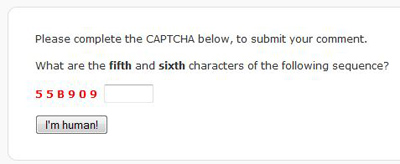
I received a huge amount of feedback from people regarding how to resolve my issue and 5 different people recommended the same simple plugin, which they said would solve the problem in minutes. They were right.

Conditional Capture for WordPress

The plugin is called Conditional Captcha for WordPress.

It works with Akismet, so whenever Akismet identifies a spam comment, it asks the sender to complete a simple captcha (see image.) If they complete it successfully, their comment is accepted. If they don’t, the comment is deleted.

Another thing I like about this plugin, is that unlike other captcha plugins, where everyone has to fill it in, this one is targeted. Unless Akismet thinks you are a spammer, you will never see it. This means it’s as quick and easy to comment here now, as it has always been.

Two additional lessons learned

After writing the blog post asking people for their feedback, two things became very clear, very fast.

The first was no surprise. It seems a lot of people dislike commenting on blogs, which use 3rd party commenting systems. Some, including me, find them unnecessarily confusing. Others dislike the idea of handing their details to a 3rd party Internet start-up or giving them access to their Twitter, Facebook accounts etc – Just to leave a comment. Many also said, they disliked how sites using 3rd party commenting systems often loaded slowly. Speed is a big deal to me, which is why I have dedicated hosting.

The second thing I learned, came as a huge surprise! I was amazed that the majority of people thought it was perfectly fine to simply turn blog comments off and have the conversations about the posts, on social networks instead. I was ready to be attacked for even suggesting this as a possibility, yet it seems people spend so much time on social networks now, that it’s easier for them to comment there, rather than on the actual blog. This was especially the case for those, like me, who usually read blogs on a tablet or phone. I currently get around 80% – 90% of my comments AWAY from this blog.

Best of both worlds

I can now provide you with the best of both worlds. Readers who like to comment here (I’ve had almost 30,000 comments so far) can do so and without any fuss. Those who like to comment on social networks will carry on doing so. I have also been able to save myself a lot of time and frustration, now that comment spam is no longer an issue.

I’m hesitant to recommend anything after using it for just 2 days. However, as I was getting as much blog comment spam in 2 days as many get in a month, I can confirm that Conditional Captcha for WordPress has been extremely accurate and easy to use. This plugin is also free, though ‘d have liked to have been given the option to either buy it or at least donate to the plugin’s creator.

Finally, I’d like to thank everyone who chimed in with their feedback, suggestions and fixes.

It’s beautifully ironic, that it was you, the reader community, who solved the problem for me.

THANK YOU!

Photo: Andrew Hyde

How to be massively more influential!

By Jim Connolly | May 15, 2012

If you would like to be massively more influential, in a really meaningful way, this post is for you!

Influence

Here’s what we know about real influence: It’s powerful. Politicians seek the endorsement of influential celebrities, because it influences how the public vote. Brands pay sports stars to appear in commercials for their fragrances, because it influences people to feel good about (and buy) their product. Companies will often pay influential former political leaders to sit on their board of directors, in order to influence investors. People with real influence have huge commercial value.

Online, what people often think of as influence is something very different. Today, many people confuse influence with something called social proof. They chase social proof, rather than build influence. So, what is social proof?

Influence and social proof are very different

Influence is real. It makes things happen. A truly influential person can take action and solve your biggest problem. They know the right people and have the respect of other, highly influential people.

For example: I once saw how one phone call from a truly influential person, stopped a business owner from losing both his business and his home. He made just one call and a 3 year old problem, which had driven the business owner to the brink, was solved in 60 seconds.

Social proof is very different. It’s about providing people with independent (looking) proof that suggests you are influential. It works well on some people, less well on others. Here are 2 common examples of social proof and how it can work:

  • When we visit someone’s blog and we see lots of people sharing their posts, that’s social proof. It works like this: If lots of people seem to value this person’s content, it must be good. This blogger must be popular.
  • When we see someone has thousands of followers on social networking sites, that’s social proof too. It works like this: If thousands of people follow this person, they must be some kind of leader, with great information to share.

Unlike influence, social proof online is super-easy to fake!

Yes, here’s the problem with social proof: Even a child can fake it. Here are some extremely common ways that people fake social proof.

  • Any blogger can make it look like every post they write has been shared by lots of people, by simply setting up lots of dummy social media accounts, which automatically share everything from that blogs RSS feed. It takes a few hours to set up 20 or 30 accounts and that blogger can make themselves look like a social media rock star, to those unaware of what they are doing.
  • Many people use the number of comments on a blog post, as social proof that the post was of value. The thing is, any blogger can post as many dummy comments on their own blog as they wish. Boom – every post they write can look like it has lots of comments. And of course, it’s easy to display a fake RSS reader number, so it looks like 50,000 or 100,000 people have subscribed to their blog.
  • Anyone can have a hundred thousand Twitter followers, by simply using a script that randomly follows a thousand people a day and attracts ‘follows’, from the 20% of Twitter users, who feel compelled to follow everyone back. If you want faster results, you can just buy 10,000 or 20,000 followers for thirty dollars a time.
    • BTW: If you want to spot who’s using the Twitter software trick to boost their numbers, it’s easy. Just click on who THEY follow and look for accounts, which have only tweeted once or twice. Because the software used for the trick works randomly, it follows people who’ve not even tweeted yet. It also follows people, who are totally inappropriate, like accounts from people who tweet in a language that person can’t read, etc. You’d be surprised how many social media and marketing ‘gurus’ use that trick!

The social proof trap

Most small business owners try to legitimately build social proof and invest valuable time into it, every working day. They work their butts off, to encourage people to comment on their blogs and share their blog posts. They strive to encourage people to follow them on Twitter, join them on LinkedIn, circle them on Google+ or ‘like’ them on Facebook. The challenge here, is that the enormous time spent on building social proof the legitimate way, could be used earning influence. Less time spent on social networking sites trying to boost your Klout score and other social proof numbers, means you have more time:

  • You have more time to do work that matters.
  • You have more time to write great content, which earns the respect of your marketplace.
  • You have more time to build deeper relationships, with fewer people – rather than shallow relationships with RHINO’s.

Develop influence, then the social proof will follow

An alternative approach is to focus on developing influence, first. When you spend the time earning a position of true influence, you will get the most impressive social proof measurement of all – When you speak, people will listen and then act!

As Seth Godin said last week:

“Hang out with people who aren’t looking for shortcuts. Learn from them.”

That’s a hard message to sell, because it goes against the online trend for instant results. However, Seth is absolutely right.

No, you can’t automate your way to true influence and you can’t buy miracle software to develop the trust of your marketplace either. You have to get them the old fashioned way… you have to earn them and it takes time.

  • « Previous Page
  • 1
  • …
  • 33
  • 34
  • 35
  • 36
  • 37
  • …
  • 60
  • Next Page »

Creative Marketing Tips

Get my best ideas delivered direct to your inbox. Just add your email below.

You can unsubscribe at any time. I respect your privacy.

Jim Connolly

Hi! I'm Jim Connolly and I use creative marketing to help small business owners increase sales, boost profits and build amazing businesses. Read more here.

Featured by

marketing advice, marketing help

Categories

  • AI (7)
  • Blogging (407)
  • Business development (493)
  • Copywriting (307)
  • Creative Marketing (1,668)
  • Email marketing & mail shots (187)
  • Professional development (545)
  • Social media marketing (358)

Hosting provider

20i hosting

Search

Recent posts

  • Sign your work. Grow your business August 17, 2026
  • Get creative: Let others market your business for free! August 7, 2026
  • Traditional marketing is dead July 27, 2026
  • The stupid game July 13, 2026
  • Hey! Not so fast! July 6, 2026
  • How to get your fees right June 23, 2026
  • A 3 shot espresso for your business June 17, 2026
  • Unproductive? You’re probably just bored June 12, 2026
  • Make AI grow your business June 8, 2026
  • It motivates people to take action, now June 4, 2026
  • Is your business one of the 50% that prospects now avoid? Probably! May 30, 2026
  • Give your best ideas away for free. Here’s why May 12, 2026
  • AI is wiping out your competitors. Now take their market share May 5, 2026
  • Powerful words for your marketing toolbox. Part 2 April 29, 2026
  • Your social media is sending an important message April 27, 2026
  • When was the last time? April 23, 2026
  • Jim, why are my sales numbers down? April 20, 2026
  • The secret sauce you were looking for, is here April 15, 2026
  • A few things worth learning, from the top small businesses April 9, 2026
  • Be optimistic. Because all this is true April 2, 2026

Creative Thinking?

My Creative Thinking Website
  • Home
  • About
  • Let’s Grow Your Business

Copyright © 2026 Jim Connolly