Jim Connolly Marketing

  • Home
  • About
    • About Jim Connolly
    • Jim’s small business marketing newsletter
    • Top Marketing Tips for 2026
    • Privacy Policy
    • How I use cookies
    • Contact
    • Disclosure
  • Let’s Grow Your Business

Getting less traffic from Google? Here’s why it may not matter soon

By Jim Connolly | July 8, 2013

google, seo, search, content marketing, writing,

If you’re one of many business owners experiencing a drop in search traffic from Google, here are 3 important changes you need to know about.

I’m also going to explain why I believe Google search traffic could be of less importance to your business soon.

The first change: Google changing the rules dramatically and often

For years, business owners have relied heavily on Google to generate online sales or inquiries. They danced the Google dance. They did what Google wanted. They invested heavily in SEO, either financially or by pouring their valuable time into making their site the way Google wanted it.

And it worked. Consistently.

Then something happened!

Google decided to change the rules dramatically and regularly. Suddenly, what worked, no longer worked. What was once within Google’s guidelines, was suddenly outside their guidelines. It’s causing a lot of small business owners a lot of pain, as they fall lower and lower down the rankings.

The best SEO experts are starting to figure out how to work with the new search engine landscape. If you can’t afford the best, it may be some time before the rest of the SEO industry catch up. However, this is not the only reason you may be seeing worse results from Google. It’s not even the most important reason.

Two far bigger changes are happening, which are lowering the value of organic (natural unpaid) search results – even if you manage to rank on the first page.

The second change: Google has made your organic search results less visible

At the same time as Google changed the way it ranks sites, it made those sites that do rank, harder for prospective customers to find.

How?

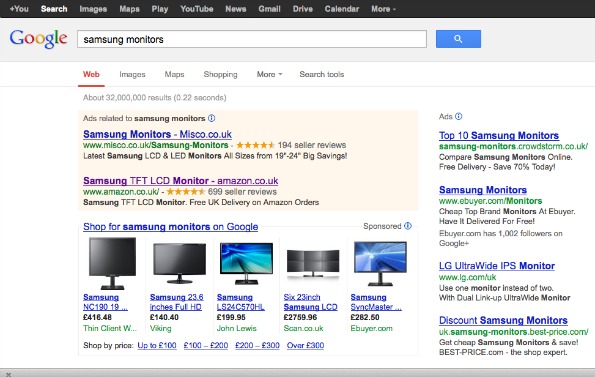
By burying your organic search results below an increasing number of Google ads. Now, for many valuable search terms, your prospective customers will see a page full of ads from your competitors, BEFORE they see your organic search results. All the results in the screen below are paid ads.

For instance: On my MacBook Pro, I needed to scroll down the screen, past ELEVEN paid ads, to see the first organic search result! (See below)
Less traffic from google, google traffic

So, even if your SEO gets you the number 1 organic slot on the first page of Google’s Search Engine Results, it may provide fewer sales or inquiries than before, because that number 1 organic search position is buried under so many paid ads.

The third change: Google sends less traffic to sites than before

The third change, is that Google search may be becoming less relevant with fewer people using it. Google search traffic could be 30% down on last year, according to a huge study!

This report from buzzfeed looked at Google search traffic to leading sites, including: The Huffington Post, The Daily Mail, Newsweek, Time, Sports Illustrated and Rolling Stone. In total, the sites it tracked have a readership of 300 million. That’s a lot of data. They found that between August 2012 and March 2013, search traffic from Google nosedived an incredible 30%. That’s a huge drop in such a short time.

However, it was expected. Here’s why!

The rise of social search

It seems that people are now increasingly asking their social networks for recommendations and answers. These networks have added a totally new dynamic, to the way we find information online.

Think about it. Which would YOU trust more:

  1. A restaurant recommendation from a trusted friend on a social network, who knows what you like.
  2. A restaurant that appears on Google via a paid ad or simply because they have good SEO.

It’s no contest.

Facebook has invested heavily in Facebook graph search, which was launched in March 2013 and looks set to eat into even more of the Google search user base. Other social networks, including Twitter and Linkedin, have search facilities too, which they are now developing constantly.

Why these changes?

Simple: Google is trying to make as much money as it can. There’s nothing surprising here. It’s a business after all.

Google has a near monopoly on search and is now leveraging that power, to get you to pay them if you want to be found.

Unless… you choose to take control of your Internet marketing away from Google and make SEO and SEM (search engine marketing), just part of your Internet marketing strategy.

Diversify your Internet marketing

This post from 2010 was largely scoffed at, when I suggested people should rely less on Google and use a wider, human focused approach to their online marketing.

Some listened to me. They started building their social networks, created communities around their businesses and stopped writing keyword optimised content for Google – choosing to write for humans instead. As a result, people now talk about their products and services and share their content all over social networks.

That’s an approach I recommend you at least add, to your overall marketing strategy.

In short: Stop relying on Google (or any one tactic) for the majority of your business. Instead, build a community (or tribe). Spread your reach and spread your risk.

You don’t have to ignore SEO, especially if you optimise for search terms, which few competitors buy Google ads for.

Just make sure your online marketing consists of more than keeping Google happy. Too many eggs in one basket is seldom a wise, long term strategy.


Content Marketing: Get better results, by removing these 3 words

By Jim Connolly | July 2, 2013

content marketing, writing, material, information

In my opinion, there’s no real need to insert the first 3 words of this sentence into your newsletter, blog or social networking update. What you write is, by default, your opinion.

Here’s why I want you to reconsider using those words in your marketing messages, unless you legally have to.

Hands up time!

The reason I am sharing this with you, is that I just caught myself writing the words ‘in my opinion’, in a blog post I am working on. It immediately dawned on me how totally redundant those words are.

Moreover, they would have significantly diluted my message — just as they can dilute your marketing messages.

Why do we feel the need to say in my opinion, when we state our opinion?

I asked myself that question and here’s what I came up with: I think it’s a way to make a point, which is harder for others to attack. If I start a statement saying in my opinion, I have distanced myself from stating it as a fact.

For example:

  • If I say the new XYZ book is terrible, I am stating what I believe to be true. The book is terrible. Period.
  • If I say that in my opinion, the new XYZ book is terrible, I’m stating that it’s possibly a great book, but I thought it was terrible.

Of course, in both those examples I am giving my opinion. The thing is, that first statement sounds so much stronger. It tells you exactly what I believe. The second statement comes with a qualification, in case you disagree. Even though, as I said a moment ago, in both cases I am giving you my opinion.

The next time you find yourself about to dilute your message or soften a statement, by saying in my opinion, think whether you really need to use those three words or not.

A word of caution

Yes, there are legal reasons why you may need to put a qualifying comment before a statement, in some circumstances. Telling people that food at the XYZ restaurant is low grade dog food, without stating it as your opinion, could land you in trouble in some parts of the world.

However, if you are stating something you believe, as I have with this post, there’s no need for you to say, in my opinion. Those three words will almost always weaken your message. We know it’s your opinion, without you telling us.

If you can make your point without those 3 words, you get to express what you believe to your readers at a deeper, more intimate and maybe more honest level. This is especially useful for those of you seeking to position yourself as a leader or authority in your field.

The Microsoft Xbox One marketing lesson

By Jim Connolly | June 20, 2013

xbox one u-turn, microsoft

There is something democratizing about marketing these days, as Microsoft’s launch of their Xbox One console demonstrated beautifully.

That’s because today, the marketplace, your prospective clients and customers, have a voice like never before.

The barrier has never been lower

A small business owner with a superb product, who knows how to market it correctly, can harness the power of online communication to attract thousands or millions of potential customers. There are countless examples of businesses, products and services, which have become massively successful, without spending megabucks on advertising or huge launch events.

Microsoft Xbox One back track

Conversely, a multi billion dollar company can misread the market and get their message horribly wrong, as happened with the launch of Microsoft’s Xbox One.

All Microsoft’s money and influence was not enough to save them from an embarrassing U-turn, when users got news of some extremely unpopular ‘features’. The Xbox One team are now trying to repair the damage caused and it will not be inexpensive or easy.

The Xbox One marketing lesson

Whatever line of business you are in and whatever size your marketing budget is, never underestimate the power of combining a great product, with effective marketing.

Unlike the Xbox One team, listen to your marketplace… THEN give them a superior product and a compelling reason to talk about it.

3 Ways to grow your business for pennies

By Jim Connolly | May 4, 2013

A lot of small business owners are struggling financially right now. So today, I am going to give you 3 ideas you can work on, which will help you grow your business for pennies or less

1. You can delight your customers more than your competitors do

This is one of the smartest marketing investments you can make. By delighting your existing customers, they become a superb source of new, high quality business. When someone receives an exceptional level of service from you, they tell people. They spread the word about your business.

Additionally, you will find that you retain your existing customers. This is really important. Otherwise, developing your business is like filling a bucket, which has a hole in it.

The key thing to remember here, is that the process of giving and receiving starts with giving. If you want your customers or clients to tell the world about you, you need to deliver an experience that’s worth talking about, first.

2. You can outsmart your competitors

Creative thinking costs nothing. By improving your creative thinking skills, you can get ahead faster and fly higher. You can spot opportunities that most people miss. You can solve problems faster and with better, more profitable answers.

Some people claim they are not creative, which is factually incorrect. We are born creative. However, to tap into our creativity and get the best results, we can all use a little help.

That’s why I have written dozens of creative thinking articles for you, on my creative thinking website. It contains dozens of free articles and videos, to show you how to think creatively, generate ideas and solve problems.

3. You can engage with your marketplace & learn what matters to them

Social networks make it easier than ever to connect with your future customers or clients. The majority of small business owners use these networks to sell or they automate their activity. They treat social networks as a broadcast medium, rather than a communication medium.

The smartest people use a human approach to social networks. They build relationships with people and listen to the needs of their marketplace. My best advice is to reach out in a human way. It works!

Bloggers: Social search and the freedom to focus on quality

By Jim Connolly | April 29, 2013

Social search is changing the game for business owners who blog and create content. Thankfully, it’s changing things in our favour and that’s what today’s post is all about.

marketing tips, marketing help

Even the best search engine is flawed

Whilst regarded by many as the best search engine available, even Google search is extremely easy to fool and still often rewards frequently updated content, over high quality content. As a result, people like myself who find it easy to write regularly, and those who use super-smart SEO to game Google, often outrank far better writers.

Social search is here… well, almost!

Thankfully, traditional search is becoming less and less relevant, as social search, (recommendations from our social networks), soar. I can either go to Google or Bing and search for what a machine ‘thinks’ is a great article about marketing – or I can see what my friends, the people I know and trust, recommend.

Google themselves really get social search and have spent hundreds of millions of dollars (maybe more) on the development of their own social network. Whilst the Google team do not call Google+ a social network, it’s a place where you can network and share ideas with like-minded people. I connect there with almost 20,000 people and it certainly feels like a social network – a darn good one, too! You can join me on Google+ here.

Social search: Recommendations from people you trust

Even if your prospective customers are not asking their networks for recommendations, it has never been easier for them to find what their friends recommend.

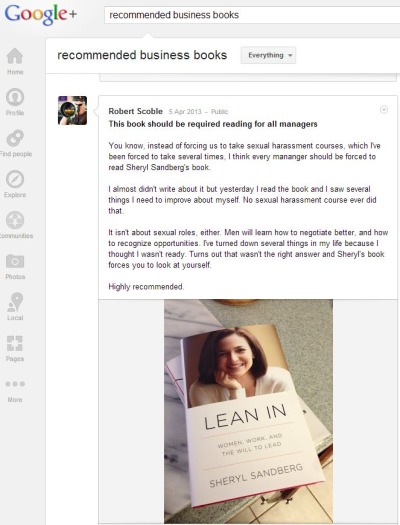
With the advent of Facebook’s social graph, you will soon be able to get that information extremely quickly. Twitter search and Google+ search are already there and make it simple to see what your friends recommend. The image below is a screen shot of what I saw, when I did a Google+ search, to see what business books were being recommended by people I know.

I trust this far more than a search result, which could well have been gamed.

social search


Social search: Focus shifts to quality

I believe that those who have been put off blogging, because they either lacked the inclination to publish regularly or the time / money to get their SEO ‘right’, should reconsider.

I suggest they change their approach, so that they focus on publishing useful blog posts, when they have something useful to share – then share it on their social networks. If they are writing something of value, their friends will share it with their friends and a subset of THEIR friends will share it…

Ironically, if enough of their friends link to it and share it, it may also do well in search engines. This is especially the case if you use basic SEO (and you should).

For WordPress bloggers, I recommend Yoast’s WordPress SEO plugin. It gives you the freedom to write exclusively for humans, whilst making your work visible by getting the basics right.

Google doesn’t own your voice!

Google is just a company, a huge and influential company, but just a company. Don’t give them too much control over what you have to say. You own your voice – not Google.

  • Tell us who you are and what you know.
  • Tell us how you can help.
  • Answer our most pressing questions.
  • Become a valued online resource.

The search engines may or may not ‘rank’ all that value. However, people will. And it’s people, not Google, who hire you. That’s the magic of social search. It’s also the model I have used here since 2008 and it works extremely well.

Blogging, social networks, newsletters: Your prospective clients are watching you

By Jim Connolly | March 13, 2013

Thanks to social networks, blogging and newsletters, your prospective clients or customers can see what you’re doing, like never before. As a result, the basics of developing your business today are extremely simple.

It’s all about DOING rather than SAYING.

  • If you want to be regarded as a leader, stop talking about leadership and start leading.
  • If you want more followers, stop asking people to follow you and do something worth following.
  • If you want people to talk about your business, stop pestering them for referrals and build a business worth talking about.

Hard to hide

Yes, you can call yourself a leader, beg people to follow you or pester people for referrals. The thing is, it doesn’t work! Why? Because your prospective clients or customers can see what you do on social networks, what you say on your blog and what you write in your newsletter. If there is a disconnect between what you claim and what you do, they notice it.

Once they smell bullshit, they’re gone – and rightly so!

The opportunity

That same exposure offers an incredible opportunity, for those who are prepared to lead, prepared to do something worth following and prepared to create a business that’s worth talking about. Just as it has never been harder for the fakes to hide – it has never been easier for the best people to get noticed.

So, with all that exposure out there, what should we do?

  • It’s easy to be a sheep. That’s why it’s so common.
  • It’s easy to offer a range of services that are just like all your competitors.
  • It’s easy to quote your favourite business guru, rather than tell us what you think.

It’s easy, but there’s no value there. There’s nothing to inspire your prospective clients. There’s nothing to justify why they should follow you, talk about you or hire you.

The decision

Every business owner today is presented with a decision, based on the following 2 options:

  1. Build a presence that confirms your leadership, originality and value.
  2. Follow the flock and always struggle; struggle to be noticed, struggle to grow your business, struggle to earn above average fees and struggle to be taken seriously.

I recommend option 1. If you think it’s the hardest option, consider the cost of being regarded as a sheep, by your prospective clients and customers.

  • « Previous Page
  • 1
  • …
  • 26
  • 27
  • 28
  • 29
  • 30
  • …
  • 60
  • Next Page »

Creative Marketing Tips

Get my best ideas delivered direct to your inbox. Just add your email below.

You can unsubscribe at any time. I respect your privacy.

Jim Connolly

Hi! I'm Jim Connolly and I use creative marketing to help small business owners increase sales, boost profits and build amazing businesses. Read more here.

Featured by

marketing advice, marketing help

Categories

  • AI (7)
  • Blogging (407)
  • Business development (493)
  • Copywriting (307)
  • Creative Marketing (1,668)
  • Email marketing & mail shots (187)
  • Professional development (545)
  • Social media marketing (358)

Hosting provider

20i hosting

Search

Recent posts

  • Sign your work. Grow your business August 17, 2026
  • Get creative: Let others market your business for free! August 7, 2026
  • Traditional marketing is dead July 27, 2026
  • The stupid game July 13, 2026
  • Hey! Not so fast! July 6, 2026
  • How to get your fees right June 23, 2026
  • A 3 shot espresso for your business June 17, 2026
  • Unproductive? You’re probably just bored June 12, 2026
  • Make AI grow your business June 8, 2026
  • It motivates people to take action, now June 4, 2026
  • Is your business one of the 50% that prospects now avoid? Probably! May 30, 2026
  • Give your best ideas away for free. Here’s why May 12, 2026
  • AI is wiping out your competitors. Now take their market share May 5, 2026
  • Powerful words for your marketing toolbox. Part 2 April 29, 2026
  • Your social media is sending an important message April 27, 2026
  • When was the last time? April 23, 2026
  • Jim, why are my sales numbers down? April 20, 2026
  • The secret sauce you were looking for, is here April 15, 2026
  • A few things worth learning, from the top small businesses April 9, 2026
  • Be optimistic. Because all this is true April 2, 2026

Creative Thinking?

My Creative Thinking Website
  • Home
  • About
  • Let’s Grow Your Business

Copyright © 2026 Jim Connolly