Jim Connolly Marketing

  • Home
  • About
    • About Jim Connolly
    • Jim’s small business marketing newsletter
    • Top Marketing Tips for 2026
    • Privacy Policy
    • How I use cookies
    • Contact
    • Disclosure
  • Let’s Grow Your Business

Google: The long and the short of it

By Jim Connolly | November 5, 2021

google indexing, google keyword, google repitition

Hundreds of the posts on Jim’s Marketing Blog have been excluded from Google’s index. Close to a thousand.

I’m told that Google’s algorithm needs me to write longer posts. It also needs me to unnaturally repeat key phrases and key words, over and over. Otherwise, no indexing.

I suggest I don’t need to change how I write.

I suggest Google needs to radically improve its horribly limited search algorithm.

Here’s the thing. I write for people, not a poorly-programmed, easy to fool algorithm. This means I write short whenever I can. This post is 32 words long. That’s all it needed.

Whilst writing short drives Google nuts, people like it.

  • It’s people whose problems I seek to solve.
  • It’s also people who hire me and people who recommend me.

The next time you have to plough through thousands of unnecessary words online, for a couple of hundred words worth of information, you’ll know why the writer did it.

Publish the process: A quick note about notes

By Jim Connolly | November 4, 2021

Jim Connolly notes

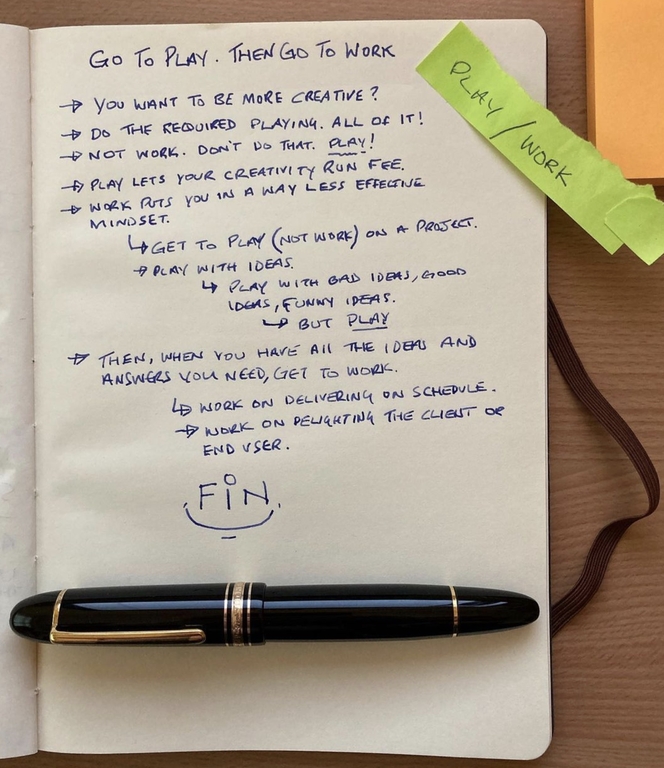
Here’s one of those publish the process posts I promised. The photo above is an example of how I take notes at my desk, when using pen and paper. I thought I’d share it today, along with some tips, and a look at how I take notes.

Some notes on note taking

You may notice it’s written in capitals. I do that deliberately. I write extremely fast in cursive, but it can be really hard for me to accurately read what I’ve written afterwards. Writing in capitals slows me a little, which also seems to result in better notes.

Although I used a fountain pen for this note, I use ballpoint pens the majority of the time. Also, when I use ballpoints, I tend to use different pigments in the note. I always have a BIC 4-in-1 (red, green, black, blue) ballpoint pen at my desk and in my bag.

I only write the main points down to begin with. This lets me get the big picture on the page, while it’s still vivid in my memory. And I peg the detail onto the main points afterwards. It works for me.

If you’re wondering, those particular notes were for a blog post. I added the detail to them later, then typed it up into WordPress for the blog.

That notebook was really cheap. I only use cheap notebooks now. I used to invest in expensive, branded notebooks ones, but found zero additional value. I find some people treat their notes like works of art. Not the content of the note. Just the overall design! Many of my best notes were scribbled onto a napkin or a scrap of paper. And some of those scribbles are still perfectly readable, 30 years later!

Almost all the handwritten notes on my client sessions are written into an iPad Pro, using the Apple Notes app. I have my pre-session notes typed up into the app. Then, notes from the session are quickly jotted down onto the same document. I switched to this approach around a year ago. It’s been a huge productivity win.

I’ve found that the key piece of advice regarding note taking, is to find what works best for you, and not to follow every so-called breakthrough in note taking. It’s the value of what you capture that matters. Not the tools. Not the design.

I hope you found something useful there.

Publish the process: Field Offices

By Jim Connolly | October 21, 2021

field offices, change scenery,

In the early days of the blog, I’d often share a look behind the scenes at my working day. It’s something I call publishing the process and today it’s back!

Just as before, I’ll share ideas I’m working on, the tools I’m using, useful new resources, the way I collect ideas… as well as things like sources of inspiration, etc.

Let’s kick things off with: Field offices

Lots of readers have asked me about how and why I use field offices. It’s something I’ve mentioned in passing in recent blog posts and newsletter articles. But never in any detail.

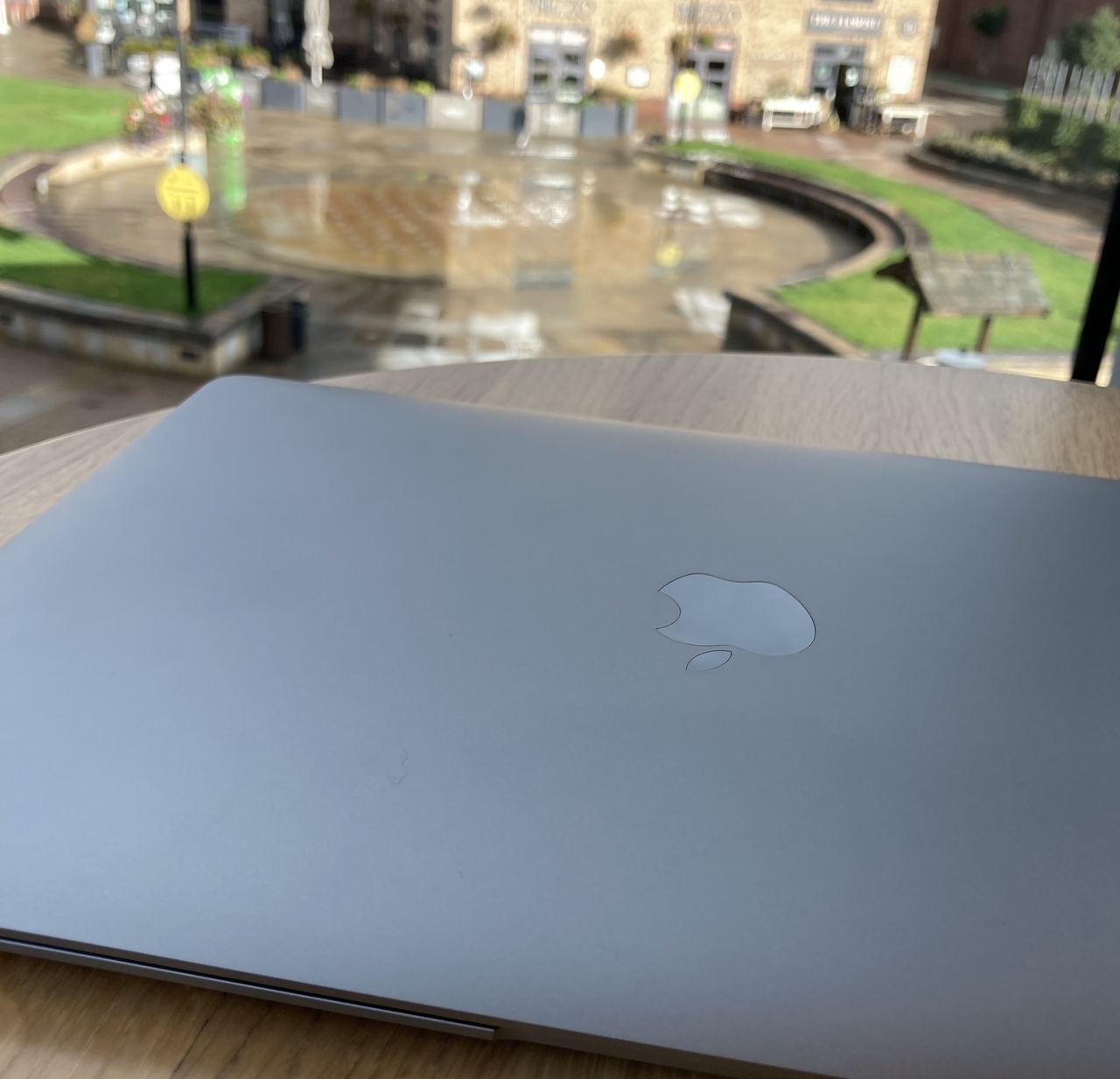
It’s a relevant topic to start with, as I sit in a field office right now; sipping espresso, with my MacBook Air finally connected to the coffee shop’s WiFi.

“[…] We get into ruts at work by following strict routines. That’s the problem! […]”

Dr. Todd Dewett

How many times have you had a great idea or flash of insight, when you’re in the shower, or when you’re at the gym or stuck in traffic?

It happens to all of us and it happens a lot.

One reason for this is that the change of scenery disrupts your routine and provides you with multiple, different inputs. Fresh sources of stimulation. And each of these influences how we think and feel, to a lesser or greater degree.

Like thousands of others, I’ve found that the same thing happens when I deliberately choose to break the routine of working from a non-traditional working environment.

Field offices offer 2 major benefits

  1. Field offices provide you with the same valuable, fresh / different ideas and insights, that often come randomly in the shower. However, by deciding to deliberately kick-start the process, you have far greater control over when it happens.
  2. Because you’re equipped with the tools you work with, for me it’s a laptop or a notebook and pen, you can capture the idea or insight and instantly get to work on it.

I also find it helps to use multiple different locations and settings. Here are the ones I’ve used recently.

  • A bench on the Chesterfield Canal.
  • A coffee shop (in the above photo).
  • The grounds of Lincoln Castle and also Conisbrough Castle.
  • My garden.
  • Sherwood Forest.

As with anything like this, some people will find it extremely useful, others will find it a lot less useful. I strongly recommend you, at least, to give it a try. See it it helps and how it helps.

How it helps?

Yes.

Field offices work in different ways for different people.

I find that they’re of most use to me when I’m stuck with an idea. Other people I know, find field offices most useful when writing reports. Whilst others, still, use them exclusively when they’ve spent too many days at a desk, and feel they ‘just need’ a change of scenery.

I hope you found this look at field offices useful. Moreover, I hope it inspires you to give it a try the next time you’re looking for a creativity boost.

The right way to write. Is wrong!

By Jim Connolly | September 12, 2021

How to write wrong

Some general advice is extremely useful or at least broadly correct. It applies to the majority of people in the majority of cases. You know… like, brush your teeth regularly.

Other general advice is a lot less helpful. It may work for the majority of people, but not for the rest of us.

The general advice on the best way to write is absolutely in that latter category. And as I get asked about this a lot, I thought I’d share some ideas with you.

The right way to write

When I started writing commercially, the general advice at the time was to get into a routine. This routine then became your recipe for writing. It was one less thing to have on your mind, so you were free to focus on your writing. From memory, some of the advice included.

  • Having a set time to write each day.
  • Writing from a familiar location; your office desk for example.
  • Avoid distraction. This one was huge.
  • Use the same keyboard, pen, paper, notebook etc.

I lasted about 2 days.

My recipe for writing turned out to be almost the exact opposite. For me, the most creative way to work is to mix things up. Some examples of how I do this includes.

  • I write from lots (and lots) of different locations. What Andy Ihnatko calls field offices. These range from my studio, my local coffee shop and Sherwood Forest, to a bench in the grounds of Lincoln Castle and a table on the canal that goes through the village where I live
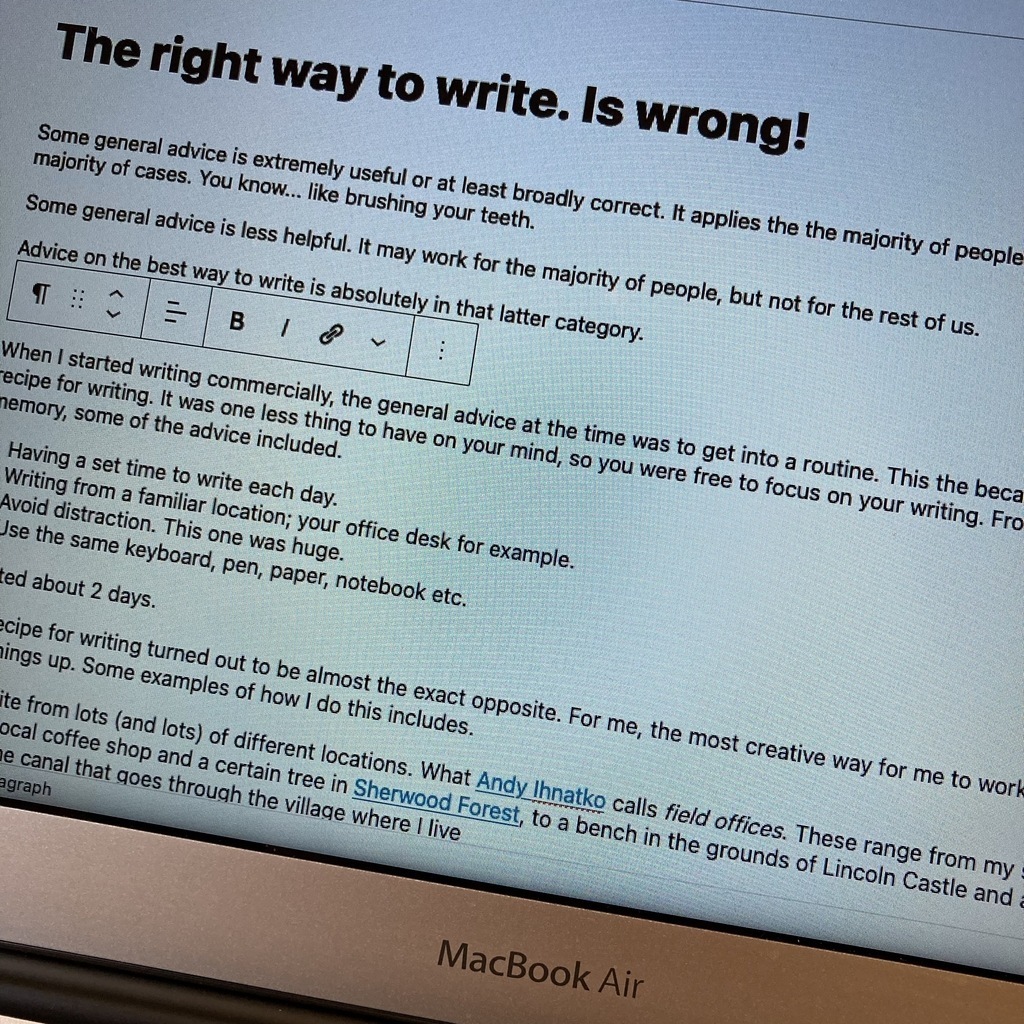
  • I write using different devices. These include an iMac in my studio, my phone, an iPad Pro, a really old MacBook Air (used for the very last time to write this post) and a MacBook Pro.
  • I write in the morning before the world wakes up (often). In fairness, that’s when around 60% of all my writing is done. However, I also write at lunchtime (here’s a recent example) and in the late afternoon.
  • I write best with background noise. This is why I do so much writing outdoors. Even when I’m in my studio, I have instrumental music playing. I find lyrics distracting.
  • I always have a pen with me and a notebook. However, the pen could be one of a dozen or more that I use regularly. The notebook depends on what’s on my production table in the studio, what’s in my back pocket, my bag or my car. I have notebooks everywhere.

My recipe for writing is also wrong

Rest assured: My recipe for writing is just as wrong (for you) as the advice I was given when I started out.

So what’s my point?

I’ve discovered that with any kind of creative work, we each need to find what works best for us. Our unique blend. Sometimes this means ignoring whatever the prevailing wisdom is. Just because something worked for one of those creative professionals selling online courses or books… it may not work for you or me.

If you have a set way to write (or do anything creative) and you’re keen to improve, here’s a suggestion. A general suggestion, which applies to almost as many people as, “brush your teeth”.

Try something new.

Mix it up (just a little).

This is especially the case if you’re struggling to create. It’s possible that a few minor revisions regarding the tools you use, the locations you create from and times of day you create, could improve things.

Good luck with discovering the right way FOR YOU to write. I Really hope you found this useful.

Google’s thin content problem

By Jim Connolly | September 5, 2021

google thin content, thin content seo

Image: Yannick Pulver. 

Business owners and marketing professionals have lots of things in common.

Here’s one of them.

Your time and your focus are of great importance. So you need access to accurate, valuable, to-the-point information.

Google is determined to ensure you don’t find it.

How?

By making to-the-point information, invisible.

It’s a problem Google has created, by not indexing something they call thin content. According to Google’s guidelines, a key element of thin content is anything that doesn’t use enough words. SEO experts think it’s a minimum of around 500 words. But a few thousand words is much better. In short, Google rewards and strongly encourages over-long content.

Even that 500 word minimum excludes about 90% of my posts from Google search. That’s okay. I optimize for people first, not Google / Alphabet.This post is under 250 words, including the title.

Here’s how many of my fellow professionals locate the best answers, fast.

Think of the experts whose work you know and trust. Find their sites. Then bookmark them. Ensure they share information there, as some expert sites are just stores. And like me, you already own their products.

Then, whenever you need trusted information, which isn’t diluted with the anti thin content fluff that Google requires, use the search function on your expert sites to get your answers.

By bookmarking the leading experts, two things happen.

1. You get information you can trust.

2. You get that information, without the confusion caused by rambling content.

Win, win.

The huge Google problem, which they don’t give a rat’s ass about

By Jim Connolly | August 29, 2021

Goolge content theft, crooks

Image: Pawel Czerwinski  

This brief post is unlikely to be indexed by Google. Although it’s written for humans (like you), it’s value will be determined by Google’s famously incompetent bot. The bot needs a minimum of three hundred words in order to get a handle on what the topic is.

That’s why lots of blog posts and articles read so poorly. They’re deliberately written over-long. The author is playing the Google game. If they want search traffic, they have to add unnecessary fluff. They also need to keep repeating certain words and phrases, or Google’s bot won’t know what to rank them for.

Google’s stolen content problem

The Google game is like most games. The vast majority play by the rules. Others don’t.

My posts are stolen by criminals within minutes (sometimes seconds) of publication. They use software to publish them and submit them to Google’s index.

In many cases, their illegal copy of my copyright protected work is chosen by Google as the original ‘canonical’ version. My original is then seen as a copy. I could even be penalized by Google, for Google’s own mistake. There’s no workable recourse. The bad guy wins.

Google search is broken. And for the foreseeable future it will stay like that. They’ve trained writers how to write for their extremely limited Google bot. The bad guys know how to profit on autopilot. It costs Google nothing. So, there’s no motivation for them to put their house in order.

When an service is as huge as Google, it’s beyond reproach. Yes, if a major publication complains, Google takes immediate action. The rest of us need to live with it. We need to play the Google game and accept theft of our work. That really sucks, but they’re Google… so!

BTW: This was 299 words.

Here’s an update: Google indexing scraped content from my blog: Part 2

  • « Previous Page
  • 1
  • …
  • 8
  • 9
  • 10
  • 11
  • 12
  • …
  • 52
  • Next Page »

Creative Marketing Tips

Get my best ideas delivered direct to your inbox. Just add your email below.

You can unsubscribe at any time. I respect your privacy.

Jim Connolly

Hi! I'm Jim Connolly and I use creative marketing to help small business owners increase sales, boost profits and build amazing businesses. Read more here.

Featured by

marketing advice, marketing help

Categories

  • AI (7)
  • Blogging (407)
  • Business development (493)
  • Copywriting (307)
  • Creative Marketing (1,668)
  • Email marketing & mail shots (187)
  • Professional development (545)
  • Social media marketing (358)

Hosting provider

20i hosting

Search

Recent posts

  • Sign your work. Grow your business August 17, 2026
  • Get creative: Let others market your business for free! August 7, 2026
  • Traditional marketing is dead July 27, 2026
  • The stupid game July 13, 2026
  • Hey! Not so fast! July 6, 2026
  • How to get your fees right June 23, 2026
  • A 3 shot espresso for your business June 17, 2026
  • Unproductive? You’re probably just bored June 12, 2026
  • Make AI grow your business June 8, 2026
  • It motivates people to take action, now June 4, 2026
  • Is your business one of the 50% that prospects now avoid? Probably! May 30, 2026
  • Give your best ideas away for free. Here’s why May 12, 2026
  • AI is wiping out your competitors. Now take their market share May 5, 2026
  • Powerful words for your marketing toolbox. Part 2 April 29, 2026
  • Your social media is sending an important message April 27, 2026
  • When was the last time? April 23, 2026
  • Jim, why are my sales numbers down? April 20, 2026
  • The secret sauce you were looking for, is here April 15, 2026
  • A few things worth learning, from the top small businesses April 9, 2026
  • Be optimistic. Because all this is true April 2, 2026

Creative Thinking?

My Creative Thinking Website
  • Home
  • About
  • Let’s Grow Your Business

Copyright © 2026 Jim Connolly